Natural Experiments & Instrumental Variables

As-if random assignment, non-compliance, and the IV estimator

Andrew Herman & Merlin Schaeffer · Department of Sociology

2026-07-28

By the end of today you can …

  1. recognise a natural experiment — “as-if random” assignment by nature — and why it trades a little internal validity for more external validity;

  2. see how non-compliance turns an RCT into an intention-to-treat design, where the offer \(Z\) is not the treatment \(D\);

  3. use an instrumental variable to recover the treatment effect for compliers — the Wald estimator \(\rho/\phi\) — and state the three IV assumptions.

Two real studies: terror attacks → xenophobia (a natural experiment), and moving out of poverty → children’s earnings (an experiment with non-compliance).

Natural experiments

Part 1 of 3

Some of the most important “treatments” can never be randomised in a lab. Sometimes the world randomises them for us.

The research question of the day

What is the average causal effect of a terrorist attack on xenophobia?

It is claimed that attacks like 9/11 shift public attitudes. Can we show it — causally?

We would need an RCT

If we could randomly assign the “treatment”, treatment and control groups would come from the same population — alike on everything, including their untreated potential outcome \(Y_0\):

\[E[Y_{0i} \mid D = 1] = E[Y_{0i} \mid D = 0]\]

so the selection-bias term vanishes and the raw difference is the causal effect \(\kappa\).

\[\begin{aligned} & E[Y_{1i} \mid D{=}1] - E[Y_{0i} \mid D{=}0] \\ &= \kappa + \underbrace{E[Y_{0i} \mid D{=}1] - E[Y_{0i} \mid D{=}0]}_{= \,0 \text{ if randomised}} \\ &= \kappa . \end{aligned}\]

But we cannot treat people with terrorism! Many sociological “treatments” are impossible — or unethical — to assign.

Nature can randomise for us

A natural experiment: exposure to treatment vs. control is as-if random — decided by nature or by forces outside the researcher’s control.

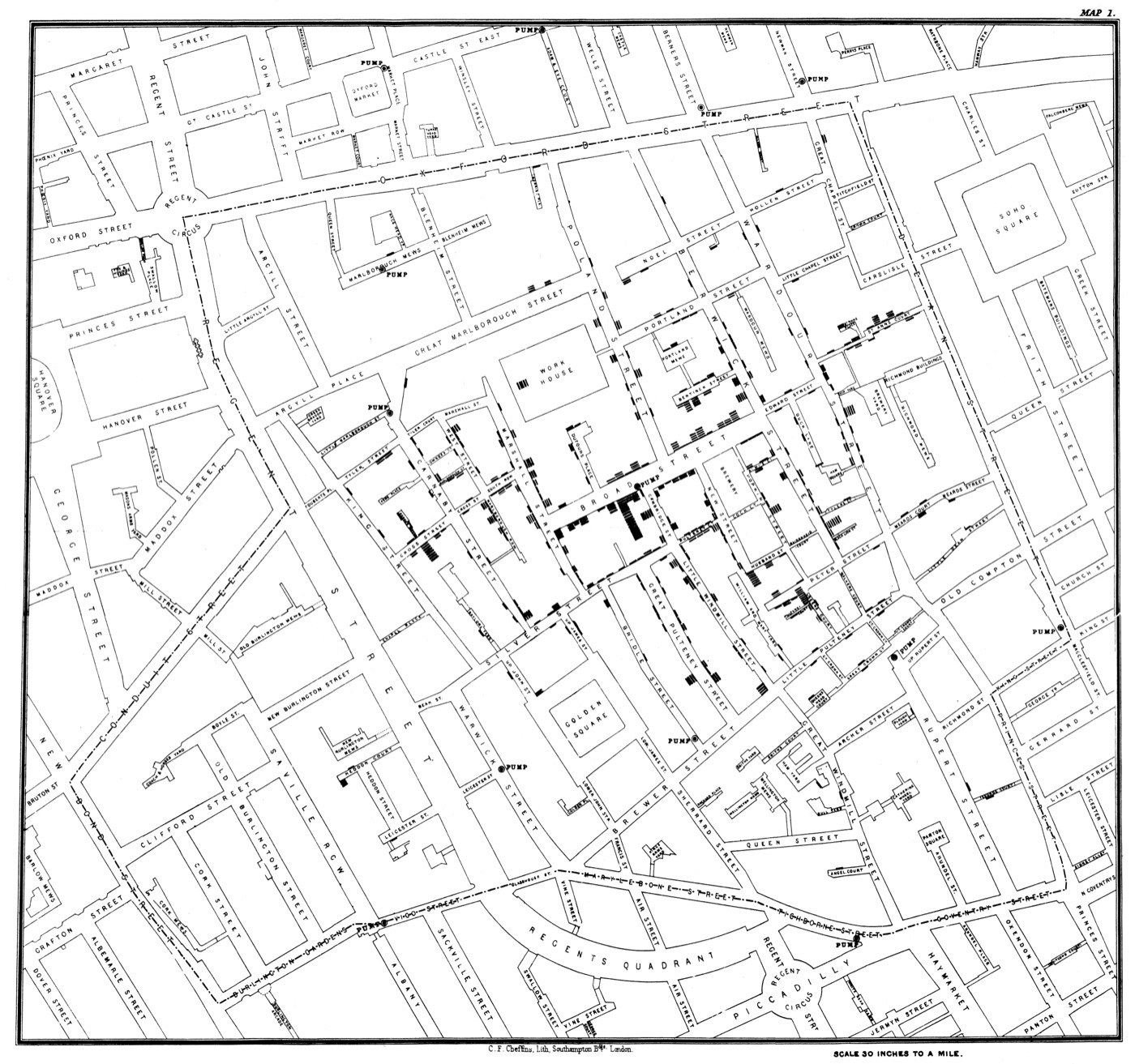
The first one: John Snow traced the 1854 London cholera outbreak to one water pump. Because rival companies’ pipes were laid haphazardly, which water a household got was as-if random — unrelated to their wealth or health (Snow, 1856).

Snow’s cholera map, 1854. Source: Snow (1856)

The Bali bombings, October 2002

Legewie (2013) spotted a natural experiment: the 2002 Bali attack struck during the European Social Survey’s fieldwork.

Whether a respondent was interviewed before or after the attack was as-if random — so “after” is the treatment group, “before” the control.

Two assumptions: (1) the interview date is as-if random (watch for reachability bias — easy-to-reach people are interviewed earlier); (2) no other event moved attitudes at the same time.
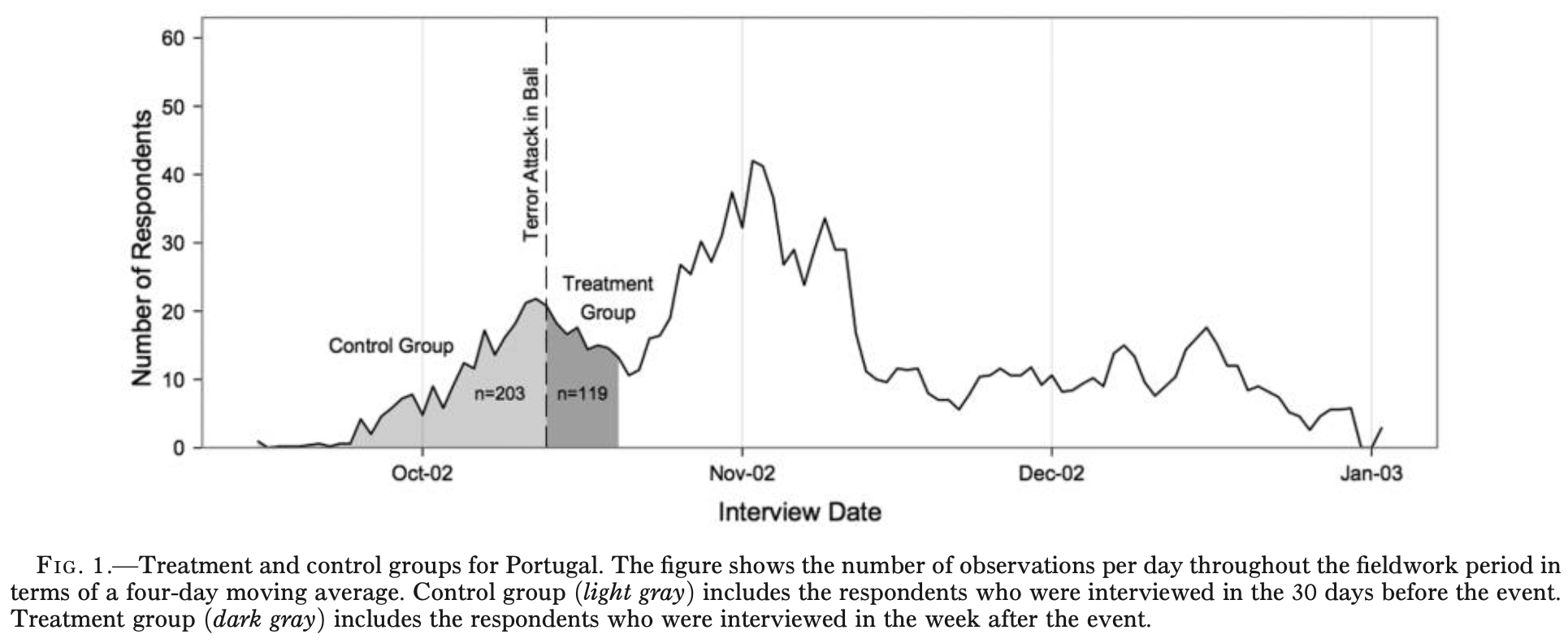
Portugal: control = 30 days before, treatment = week after. Source: Legewie (2013)

RCT vs. natural experiment
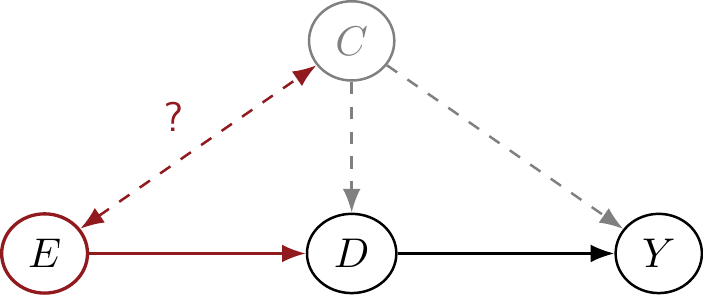
Internal validity — the RCT wins. The researcher controls assignment, so the intervention \(I\) is known to be random. We are sure no confounder \(C\) sneaks in.

External validity — the natural experiment wins. We study a real event \(E\), not an artificial lab intervention — findings travel better. The price: we must assume \(E\) is as-if random (the “?” arrow), not know it.

Learning goal 1: terror can raise xenophobia

Because the interview day is as-if random, Legewie estimates the causal effect of the Bali attack on anti-immigrant attitudes — country by country, with plain weighted OLS.

The attack significantly raised xenophobia in Portugal, Poland & Finland — but had no detectable effect in Great Britain, the Netherlands, or Norway. The same shock, different societies: why is the next research question (Legewie, 2013).

Finding the natural experiment — not the statistics — is the hard, creative part.
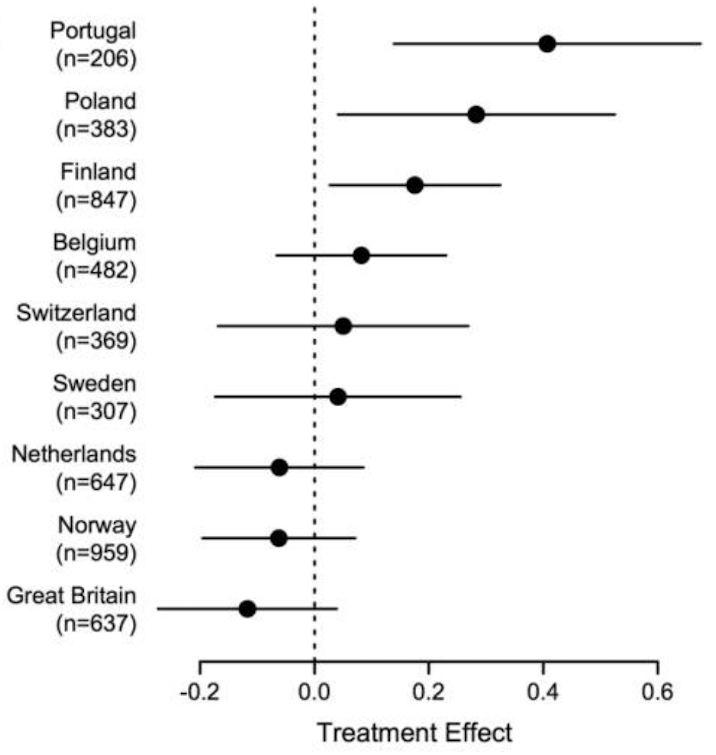
Source: Legewie (2013)

Break

Your turn: exercise 1

You replicate Legewie: estimate the Bali effect for Portugal and Sweden, and make a coefficient plot — real AJS-style analysis.

Open exercise 1 in a new tab ↗

Non-compliance & intention-to-treat

Part 2 of 3

Even a real RCT hits a snag: you can offer a treatment, but you cannot force people to take it.

Does your neighbourhood shape your future?

Moving to Opportunity (MTO): one of the largest social-science RCTs ever. ~4,600 low-income families in high-poverty housing were randomly offered a voucher to move to a low-poverty neighbourhood.

The question: does growing up in a poor neighbourhood hold children back — causally?

The catch: the lottery randomised the offer, not the move. Families could decline. So the randomly assigned \(Z\) (offer) is not the treatment \(D\) (actually moving).

Only some compliers move

Among families with young children who were offered the experimental voucher, only about 48% actually moved (Chetty, Hendren, and Katz, 2016).

This is non-compliance: the random \(Z\) (the offer) and the treatment \(D\) (moving) come apart, \(|r_{Z,D}| < 1\).
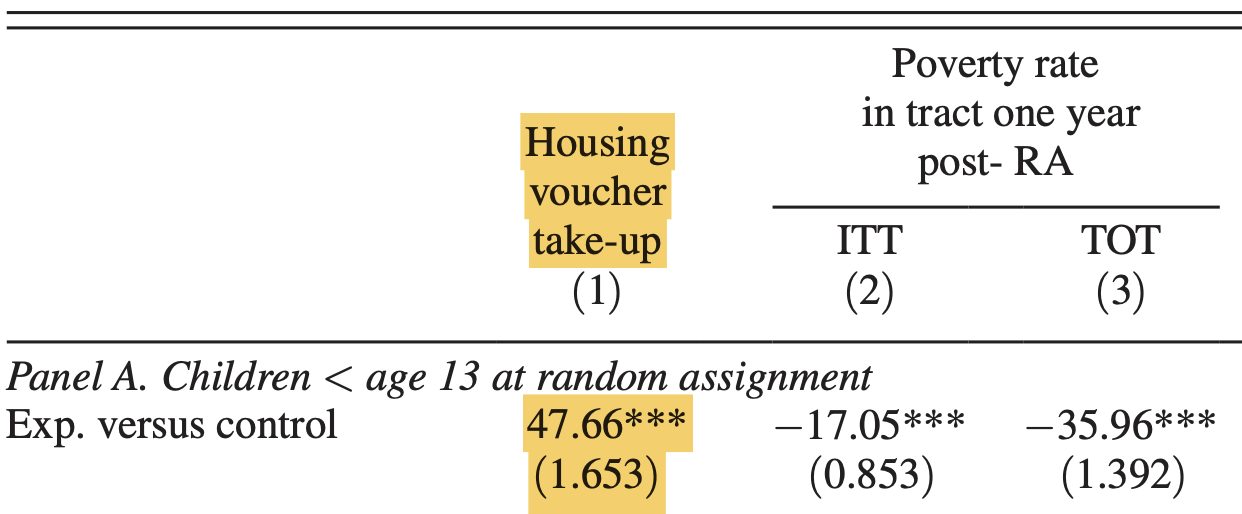
Take-up ≈ 0.4766. Source: Chetty, Hendren, and Katz (2016)

The intention-to-treat effect

Compare everyone offered the voucher to everyone not offered — regardless of who moved. Because the offer was randomised, this intention-to-treat (ITT) difference is a clean causal effect: +$1,624 in adult earnings for kids offered the move.

But of what? It is the causal effect of being offered the move \(Z\)not of actually moving \(D\). It is diluted: a big effect for the ~48% who moved, mixed with zero for the ~52% who stayed.
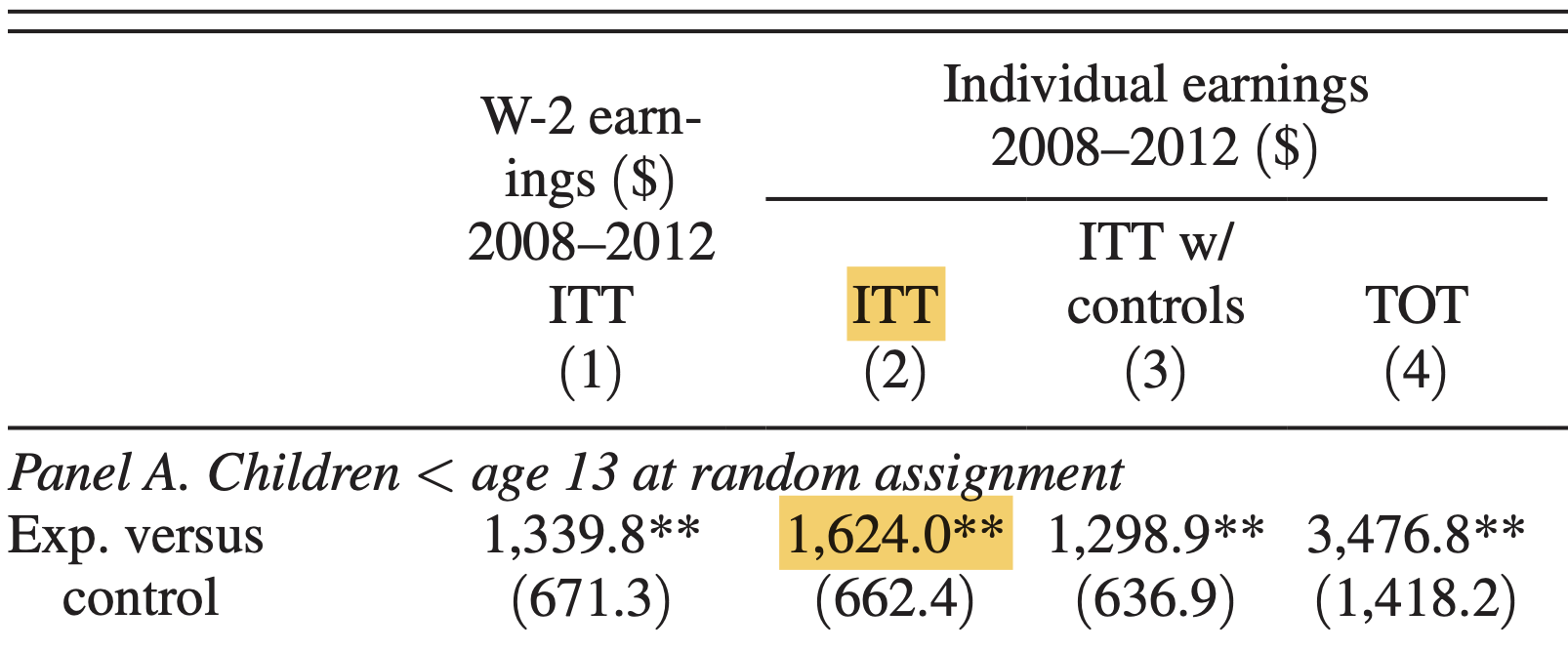
ITT ≈ +$1,624. Source: Chetty, Hendren, and Katz (2016)

RCT vs. intention-to-treat

Full-compliance RCT: the intervention is the treatment. \[|r_{I,D}| = 1 \;\Rightarrow\; I = D\] The randomised difference is the treatment effect directly.

ITT / non-compliance: the offer only nudges the treatment. \[|r_{Z,D}| < 1 \;\Rightarrow\; Z \neq D\] The randomised offer injects some random variation into \(D\) — enough to work with.

That leftover random variation in \(D\) is exactly what an instrumental variable exploits.

Instrumental variables

Part 3 of 3

Use the randomly-assigned offer as an instrument to recover the effect of the treatment itself.

The cast of characters

Every IV argument juggles the same seven players. Anchor them in the MTO study:

Symbol Role In Moving to Opportunity
\(Z\) Instrument — randomly assigned the voucher offer (the lottery)
\(D\) Treatment — what we care about actually moving to a low-poverty area
\(Y\) Outcome the child’s adult income
\(C\) Confounders — why we can’t just compare movers ambition, family resources …
\(\phi\) First stage \(Z \rightarrow D\) offer → move \(= 0.48\)
\(\rho\) Reduced form \(Z \rightarrow Y\) (the ITT) offer → income \(= \$1{,}624\)
\(\lambda\) What we want \(D \rightarrow Y\) move → income \(= \rho/\phi \approx \$3{,}400\)

Keep this in view — every formula today is just these seven symbols.

An instrument, and its three demands

Goal: the causal effect \(\lambda\) of the treatment \(D\) on outcome \(Y\).

Three requirements for an instrument \(Z\):

  1. First stage: \(Z\) has a real effect \(\phi\) on \(D\) (testable).
  2. As-if random: \(Z\) is unrelated to confounders \(C\) (by design).
  3. Exclusion restriction: \(Z\) affects \(Y\) only through \(D\) (not testable — argue for it).
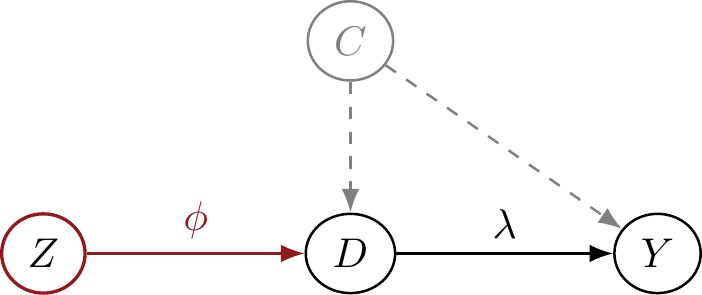
The exclusion restriction is fragile

Winning the lottery clearly makes families move (first stage ✓) and was random (✓) — two boxes ticked.

Discuss: could the random offer still reach a child’s income through some other path than moving — and so ruin the instrument?

Yes — if winning also sparked optimism that lifted income directly, whether or not the family moved. Then \(Z\) reaches \(Y\) through a second path: the exclusion restriction breaks. It is the one requirement you cannot test — you must argue it is implausible.

A violated exclusion restriction
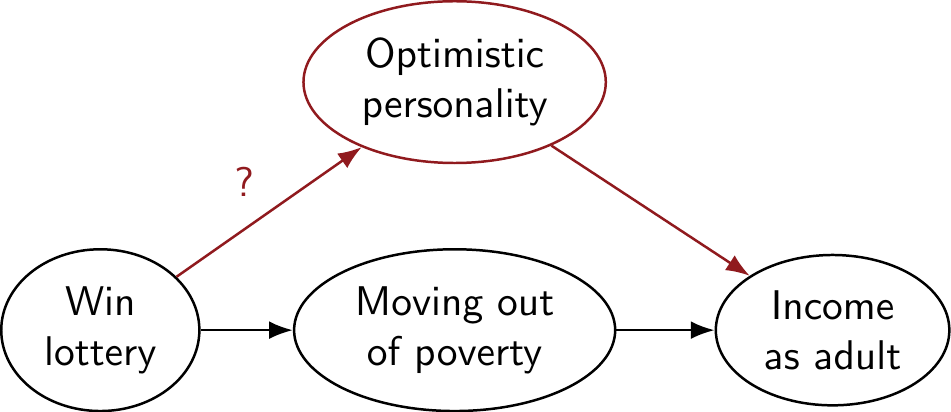
Why divide? The dilution intuition

The offer only moved 48% of families. So the offer’s effect on income — the $1,624 ITT — is a diluted effect of moving: a big gain for the ~48% who moved, blended with zero for the ~52% who did not.

To undo the dilution, scale it back up by the share who actually moved: \[\lambda = \frac{\$1{,}624}{0.48} \approx \$3{,}400\]

In one line: a weak nudge that still shifted incomes must mean each real mover was affected a lot. Dividing the (small) reduced form by the (small) first stage recovers that full per-mover effect.

If everyone had complied (\(\phi = 1\)), the ITT would be the treatment effect — no scaling needed. Non-compliance is exactly why we divide.

The Wald estimator: a ratio

Two effects we can estimate cleanly, because \(Z\) is random:

First stage\(Z\)’s effect on the treatment: \[\phi = E[D \mid Z{=}1] - E[D \mid Z{=}0]\]

Reduced form\(Z\)’s effect on the outcome (the ITT): \[\rho = E[Y \mid Z{=}1] - E[Y \mid Z{=}0]\]

If \(Z\) works only through \(D\), then \(\phi \times \lambda = \rho\), so: \[\lambda = \frac{\rho}{\phi} = \frac{\text{reduced form}}{\text{first stage}}\]

For MTO: \(\lambda = \dfrac{\$1{,}624}{0.4766} \approx \mathbf{\$3{,}400}\) — the effect of moving for those who move because of the offer.

IV is LATE — only for compliers

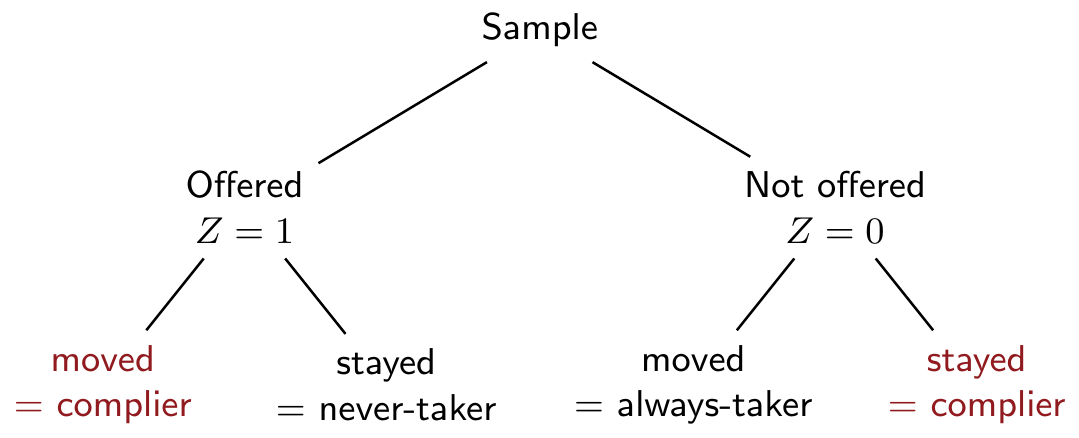
The instrument only moves the compliers — people who take the treatment because they were assigned it. So IV recovers a Local Average Treatment Effect: \[\lambda = E[Y_{1i} - Y_{0i} \mid \text{complier}]\]

  • Why only compliers? Never- and always-takers do the same thing whether offered or not — the offer shifts neither their \(D\) nor their \(Y\), so they add nothing to \(\rho\) or \(\phi\) and cancel out of the ratio. Only compliers are left.
  • Monotonicity: assume no defiers (who do the opposite of their assignment). Almost always reasonable.

Why a new letter? In Lecture 6 an RCT gave us \(\kappa\) — the effect for everyone. An instrument is weaker: \(\lambda\) is the same kind of causal effect, but only for the compliers. Same idea, narrower population — hence \(\lambda\), not \(\kappa\).
Learning goal 2: neighbourhoods matter

Instrumenting the move with the random voucher offer, Chetty, Hendren, and Katz (2016) recover the effect of actually moving as a young child: about +$3,477 in annual adult earnings.

Growing up in a low-poverty neighbourhood causally raises children’s later earnings — powerful evidence that place shapes destiny, for the compliers whose move the lottery caused.
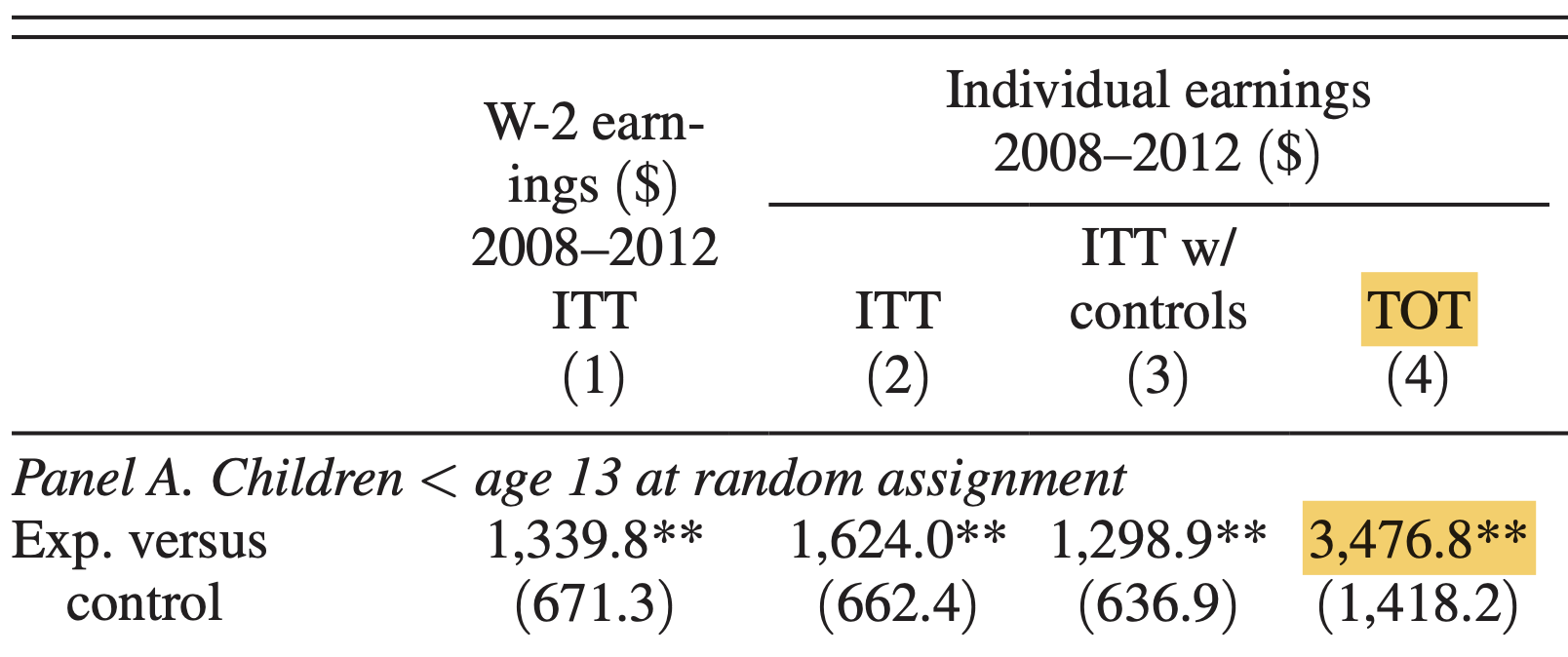
IV / treatment-on-treated ≈ +$3,477. Source: Chetty, Hendren, and Katz (2016)

Your turn: exercise 2

Does arresting domestic-violence suspects deter repeat offences? The Minneapolis experiment had non-compliance too — you compute the IV estimate yourself.

Open exercise 2 in a new tab ↗

Today’s general lessons

  1. A natural experiment exploits as-if random exposure created by the world — less control than an RCT, but real events and better external validity.

  2. With non-compliance, the randomised offer \(Z\) is not the treatment \(D\). The intention-to-treat effect is the clean causal effect of the offer — diluted by everyone who didn’t comply.

  3. An instrumental variable uses the random \(Z\) to recover the treatment effect \(\lambda = \rho/\phi\)if the first stage is real, \(Z\) is as-if random, and the exclusion restriction holds.

  4. IV estimates a LATE: the effect only for compliers, assuming no defiers (monotonicity). It is silent about never- and always-takers.

Check yourself: today’s goals

  • Explain why an interview date, or a lottery, can serve as “as-if random” assignment — and what could break that.
  • Say why the ITT effect of being offered a move is not the effect of moving, and what non-compliance does to \(r_{Z,D}\).
  • Compute an IV estimate as reduced form ÷ first stage, and state whose effect (which group) it is.

Shaky on any of these? That is what this week’s Absalon quiz and the Friday exercise class are for.

Today’s important functions

  • estimatr::lm_robust(y ~ z, weights = ...): the reduced form (\(\rho\), effect of the offer) and — with the treatment as the outcome — the first stage (\(\phi\)).
  • The Wald estimator is then just arithmetic: lambda <- rho / phi. No special function needed.
  • masteringmetrics::mdve: the Minneapolis domestic-violence experiment (exercise 2).
  • (Next week) ivreg::ivreg(y ~ d | z) runs the first stage, reduced form and division in one step — 2SLS.

References

Chetty, R., N. Hendren, and L. F. Katz (2016). “The Effects of Exposure to Better Neighborhoods on Children: New Evidence from the Moving to Opportunity Experiment”. In: The American Economic Review, pp. 855-902.

Legewie, J. (2013). “Terrorist Events and Attitudes toward Immigrants: A Natural Experiment”. In: American Journal of Sociology, pp. 1199-1245.

Snow, J. (1856). “On the Mode of Communication of Cholera”. In: Edinburgh Medical Journal, pp. 668-670.